
Written by the maker of Stress Relief. Product examples describe our own app; this is not an independent review or medical advice.
The short answer
Before a study break, write the next small action on your notes. Set a two-minute timer, spend most of the pause on one simple activity, then put it away when the timer ends. You can doodle, get a drink or use an available calming game; an app is optional.
Leave yourself a useful place to return
A bookmark says where you stopped. A return note says what to do next. Write something concrete, such as “read the example under the diagram,” “check the units in question four,” or “make three vocabulary cards.” Avoid a broad instruction such as “study harder.”
For a group project, tell the other person you are taking a brief pause and when you expect to return. For a timed exam or assessment, follow its break and device rules; this routine is for ordinary study sessions.
Choose a different action from the one you left
If you have been reading on a screen, try looking away, refilling a glass or drawing loose lines on paper. If you have been writing by hand and want a phone activity, choose something with little to read. The choice is about variety and preference, rather than a claim that a specific activity improves memory.
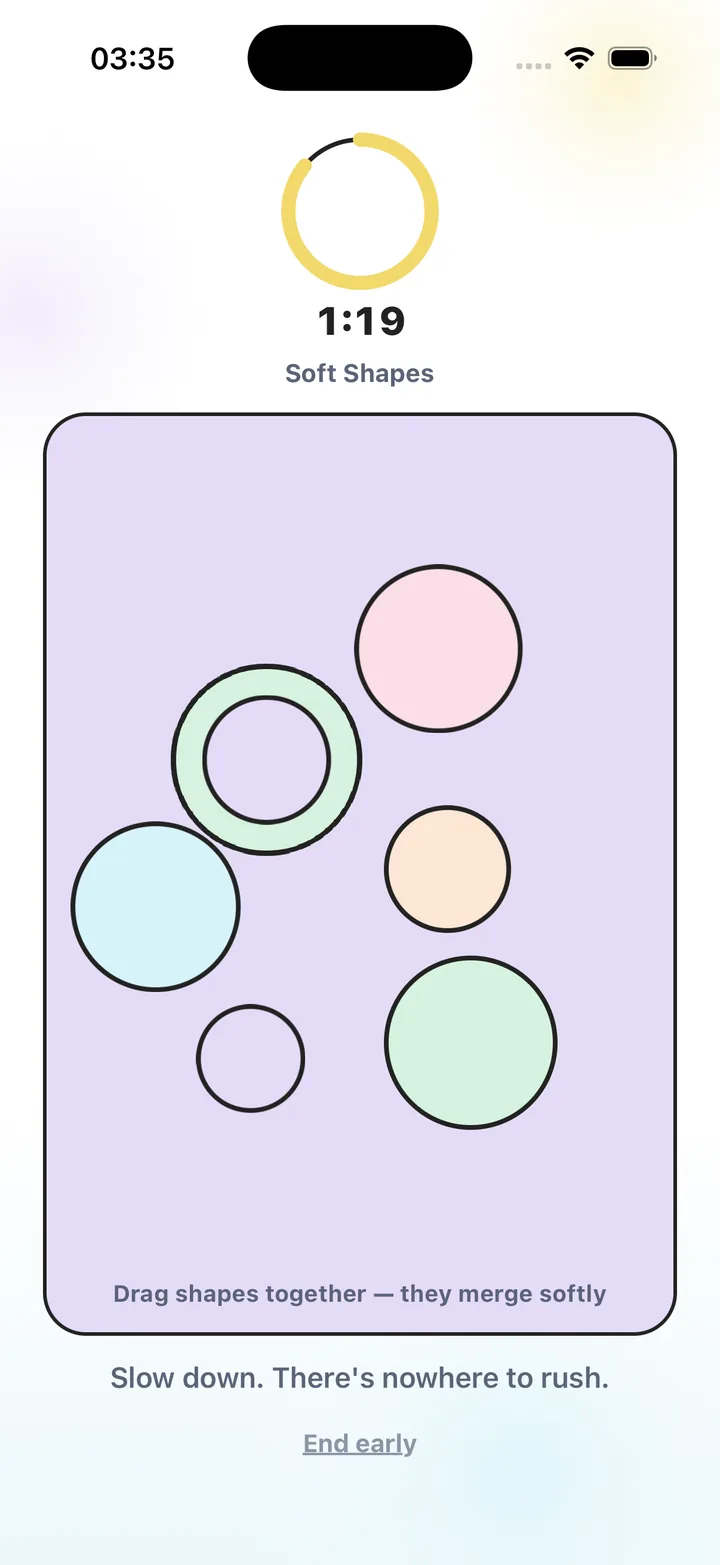
Bubble Pop offers tapping, Soft Shapes offers dragging, and Water Ripples responds to a moving finger. Stress Relief has no scores or advertising. Use an activity already available to you so the break does not become a download or purchase decision.
An example two-minute schedule
Treat the times as a rough outline. Spend the first twenty seconds marking your place and putting the study material aside. Use about eighty seconds for one activity. Keep the final twenty seconds for closing it and reading your return note.
A two-minute timer is a separate time boundary; it is not a claim that the app has a two-minute Instant Reset setting. Its Instant Reset choices are one, three or five minutes. For this routine, use your own timer and leave a game early when needed.
- Keep the return note beside the book or keyboard.
- Choose the activity before opening your phone.
- Skip feeds, messages and research during this particular pause.
- Take a longer practical break when you need food, movement or the bathroom.
When the timer rings
Stop at the next convenient touch rather than trying to complete a pattern. Put the phone out of the way and do only the small action on your note. Decide the next study block after that first action, rather than planning the entire evening during the break.
If you repeatedly need more time, change the plan. Two minutes is an option for a brief gap, not a rule you must follow or proof of how well you are studying.
Try it at your next chapter break
- Write one return action
Choose the first sentence, question or correction you will work on when you come back.
- Start a two-minute timer
Use a timer you can hear or notice without repeatedly checking the screen.
- Do one simple thing
Doodle on paper, refill a drink, look outside or briefly play an available game.
- Close and return
End the activity, put it away and follow the note you left yourself.
Frequently asked questions
Will a two-minute break improve my grades?
There is no grade or concentration guarantee. This is a practical way to bound a pause and make returning less ambiguous.
Can I use a game during a study break?
Yes, if that fits your setting and you can leave it on time. A screen-free activity is also a complete option.
Should I take a break after every page?
Choose stopping places that fit the task. You do not need to interrupt a useful study block to meet a fixed schedule.
Sources and product references
- Official Stress Relief app facts
Product information from Omnivatis, the publisher. These guides describe our own app and are not independent reviews.
- Stress Relief: Relaxing Games on the App Store
Check current iPhone availability, purchase options and published app information.
Stress Relief is a wellness app. It is not a medical device, does not diagnose or treat any condition, and is not a substitute for professional care. If you are struggling, please talk to a qualified professional.